

Most first-time EV owners make the same expensive mistake. They walk into the charger aisle, see “48 amp” and “50 amp” badges glowing like horsepower numbers on a sports car, and buy the biggest one. Faster is better, right?
Wrong. And it’s not a small mistake — it’s a $150-to-$4,500 mistake, depending on how much you overspend on hardware and on the electrical panel upgrade you may not have needed.
Here’s the uncomfortable truth the marketing brochures skip: your car decides how fast it charges, not your charger. The box on your wall can only offer power. Your vehicle’s onboard charger accepts it. And the actual speed is always set by whichever number is lower.
This is the “Amps Trap.” Let’s walk through it, with real numbers, real product picks, and embedded videos from the people who actually test this stuff for a living.
The wall vs. the car: who’s really in charge?
A Level 2 charger is not a battery. It’s a smart gatekeeper. It pulls 240 volts from your home, and pushes amperage into your car — but only as much as the car asks for.
Your car has an onboard charger (OBC). It’s a physical component with a hard ceiling. A Chevrolet Bolt’s OBC maxes out at about 7.7 kW (32 amps). A Nissan LEAF tops out around 6.6 kW. A Tesla Model 3 Standard Range? Also ~7.7 kW. Even a Ford Mustang Mach-E or a Tesla Long Range taps out at 11.5 kW (48 amps).
So if you bolt a 48-amp charger onto a Bolt, you paid for 11.5 kW of delivery and your car silently takes 7.7 kW. The extra 3.8 kW of capacity? It lives in the wall, unused, forever. You bought a V8 and drive it like a four-cylinder.
Golden line: The charger is the messenger. The car writes the speed limit.
The math everybody skips (it’s actually simple)
Charging power is just multiplication:
Amps × 240 volts ÷ 1,000 = kW
And roughly: kW × ~3.5 miles = miles of range added per hour (varies by vehicle efficiency).
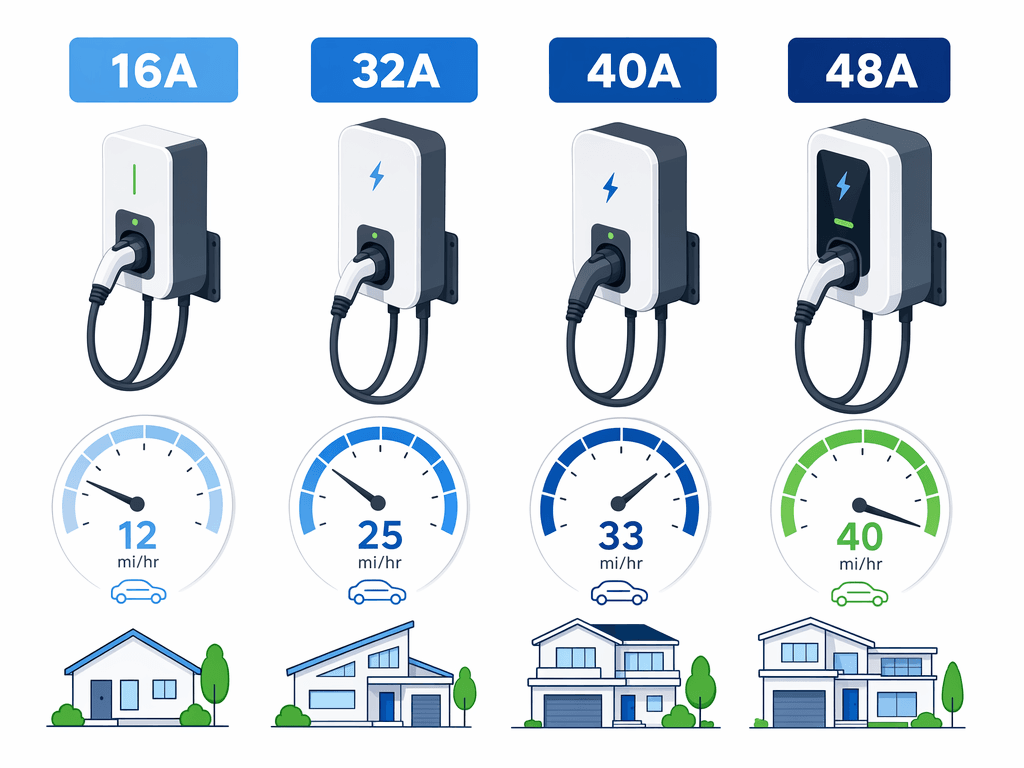
| Charger amps | Breaker needed (NEC 125%) | Power @ 240V | Miles added / hour | Best for |
|---|---|---|---|---|
| 16A | 20A | 3.8 kW | 12–15 mi | PHEVs, tiny commutes |
| 24A | 30A | 5.8 kW | 18–22 mi | Short commuters |
| 32A | 40A | 7.7 kW | 25–30 mi | The sweet spot |
| 40A | 50A | 9.6 kW | 30–37 mi | High-mileage drivers |
| 48A | 60A | 11.5 kW | 37–45 mi | Big batteries, fast turnarounds |
The average American drives 37 miles a day (Bureau of Transportation Statistics). A 32-amp charger adds ~25 miles per hour. That means less than two hours of charging replaces a full day of driving. Even on a 6-hour overnight window, you’re adding 150 miles — four times the daily average.
You almost never need 48 amps. You think you do, because the numbers look bigger.
The 80% rule: why your breaker is bigger than your charger
The National Electrical Code treats EV charging as a “continuous load” — it runs for hours. So the breaker must be rated at 125% of the charger’s draw. That’s not a suggestion; it’s code.
- 32A charger → 40A breaker
- 40A charger → 50A breaker
- 48A charger → 60A breaker
Here’s why that matters for your wallet: that 60A breaker adds ~11,520 volt-amps to your home’s load calculation. A 40A breaker adds only ~7,680. That ~3,840 VA gap is frequently the difference between “your panel is fine” and “you need a $2,000–$4,500 service upgrade.”
A master electrician’s take: “Bigger isn’t always better, especially when it means the difference between a $500 circuit addition and a panel upgrade.” Match the charger to the panel you actually have.
Match the charger to YOUR car (real onboard limits)
Before you spend a cent, find your car’s AC acceptance rate. Here are common 2024–2026 figures:
| Vehicle | Max AC power | Equivalent max amps |
|---|---|---|
| Chevrolet Bolt EV | 7.7 kW | 32A |
| Nissan LEAF (Plus) | 6.6 kW | ~28A |
| Tesla Model 3 / Y (Standard) | 7.7 kW | 32A |
| Tesla Model 3 / Y (Long Range) | 11.5 kW | 48A |
| Ford Mustang Mach-E | 11.5 kW | 48A |
| Hyundai IONIQ 5 | 11.5 kW | 48A |
| Ford F-150 Lightning | up to 19.2 kW | up to 80A |
| Most PHEVs | 3.3–7.7 kW | 16–32A |
Golden line: Check your car’s spec sheet before your credit card. The speed limit is printed on the car, not the charger.
Want the full yearly rundown from the most trusted tester in the space? Tom Moloughney (State of Charge) lives with 100+ chargers in his garage and tests them relentlessly. His 2025 roundup is the single best 36 minutes you can spend before buying:
Plug-in vs. hardwired: the 40-amp ceiling nobody mentions
There’s a regulatory reason some chargers stop at 40 amps and others hit 48:
- Plug-in (NEMA 14-50): capped at 40 amps continuous by safety code, even on a 50A circuit. The outlet itself is the weak point under daily heat cycles.
- Hardwired: connects directly to the breaker, no plug in the middle, so it can safely run 48 amps on a 60A circuit.
So if you want maximum speed, you’re looking at a hardwired install. If you want flexibility (renters, movers, easy replacement), a NEMA 14-50 plug-in at 40A is plenty for most people — and it skips a lot of electrician cost.
Future-proof with wiring, not hardware: if you’re already paying an electrician, run wire sized for a 50–60A circuit even if you set the charger to 32–40A today. Swapping the charger later is easy; opening the walls again is not.
For a tighter, ranked comparison of the top 7 units on the market, this walkthrough is genuinely useful:
Our picks: high-rated Level 2 chargers (matched to the right buyer)
Prices and ratings verified July 2026. Links are Amazon Associates links — if you buy through them, we may earn a commission at no extra cost to you.
1. Best overall / most flexible — ChargePoint Home Flex
Up to 50A (hardwired) or 40A (plug-in) · J1772 or NACS · WiFi app · ~4.4☆ (1,600+ reviews) · ~$499–$549
The standout: adjustable amperage from 16A to 50A in the app. Buy it, install it on whatever breaker your panel supports today, and dial it up later if you upgrade your service. Best-in-class app, energy tracking, Alexa/Google integration. If you only buy one charger and want it to outlive your next car, this is it.
🔗 ChargePoint Home Flex on Amazon
2. Best value — Emporia Smart Level 2
48A (hardwired) / 40A (NEMA 14-50) · J1772 or NACS · WiFi · ~4.7☆ (2,000+ reviews) · ~$399–$459
State of Charge gave it one of the highest scores he’s ever awarded. Full smart features — scheduling, kWh tracking, off-peak charging — at a price well below premium rivals. The only real catch: J1772 means Tesla drivers use an adapter. For a one-EV household that wants data without the premium price, it’s hard to beat.
🔗 Emporia Smart Level 2 on Amazon
3. Best for Tesla / mixed garages — Tesla Universal Wall Connector
48A · hardwired · NACS + built-in J1772 adapter · ~4.8☆ · ~$530–$600
The “Universal” version has a magic trick: a J1772 adapter that lives on the connector, so it charges any North American EV — Tesla or not. 44 miles/hour, seamless Tesla app, power-sharing for up to 6 units. Hardwired only. If your household is all-Tesla today but you might switch brands later, this is the future-proof pick. (One recurring complaint: the adapter can stick — minor, but worth knowing.)
🔗 Tesla Universal Wall Connector on Amazon
4. Best rugged / no-frills — Grizzl-E Classic
40A · NEMA 14-50 · cast-aluminum case · UL certified · ~4.6☆ (3,700+ reviews) · ~$300–$399
Built in Canada, IP67-rated, set your amps (16/24/32/40) with internal DIP switches to match your wiring. No app, no account, no drama — just a tank of a charger that survives snow, ice, and being run over. Perfect for outdoor carports, cabins, and anyone who wants “plug it in and forget it.”
5. Best fast & affordable — EVIQO Level 2 (Gen 2)
48A (hardwired) / 40A (plug-in) · J1772 · WiFi · ~4.7–4.8☆ (2,000+ reviews) · ~$399–$429
A consistent #1 best-seller on Amazon’s EV charger category. 11.5 kW hardwired, app with 1-amp increment adjustments, 25-ft cable, UL/ETL/ENERGY STAR certified, 3-year warranty. Real-world owner reviews praise easy install and solid build at a sharp price. Here’s an honest hands-on review charging both a Hyundai IONIQ 5 and a Tesla Model Y:
How to choose in 3 steps
- Find your car’s AC limit. Look up the onboard charger spec. That’s your ceiling. Don’t buy above it.
- Check your panel. Have an electrician (or a load-calc tool) confirm spare capacity. If you’re tight, a 32A charger on a 40A breaker often fits where a 48A unit would force a costly upgrade.
- Be honest about miles. Under 50 mi/day? 32A is plenty. Two EVs, long commute, or a 100+ kWh truck you drain past 50%? Step up to 40–48A — if your car and panel can use it.
Golden line: Buy the amps your life actually uses. Everything above that is a decoration on your garage wall.
Quick FAQ
Will a higher-amp charger damage my EV? No. Your onboard charger controls the draw. A bigger charger only offers more; the car takes what it can.
Is plug-in (NEMA 14-50) safe at 40A? Yes, with a heavy-duty, industrial-grade receptacle. Daily heat cycles are the known failure mode, so don’t cheap out on the outlet.
Do I need 48 amps? Only if you drive 100+ miles daily, need fast turnaround (rideshare, multi-car), or have a large battery you routinely deep-cycle. Everyone else: 32–40A.
Plug-in or hardwired? Plug-in for flexibility and lower install cost (capped at 40A). Hardwired for max speed (48A+) and best weather resistance.
Disclosure: This post contains Amazon Associates links. If you purchase through them, we may earn a commission at no additional cost to you. We only recommend products we’d wire into our own garage. Always confirm specs with a licensed electrician before installation.